

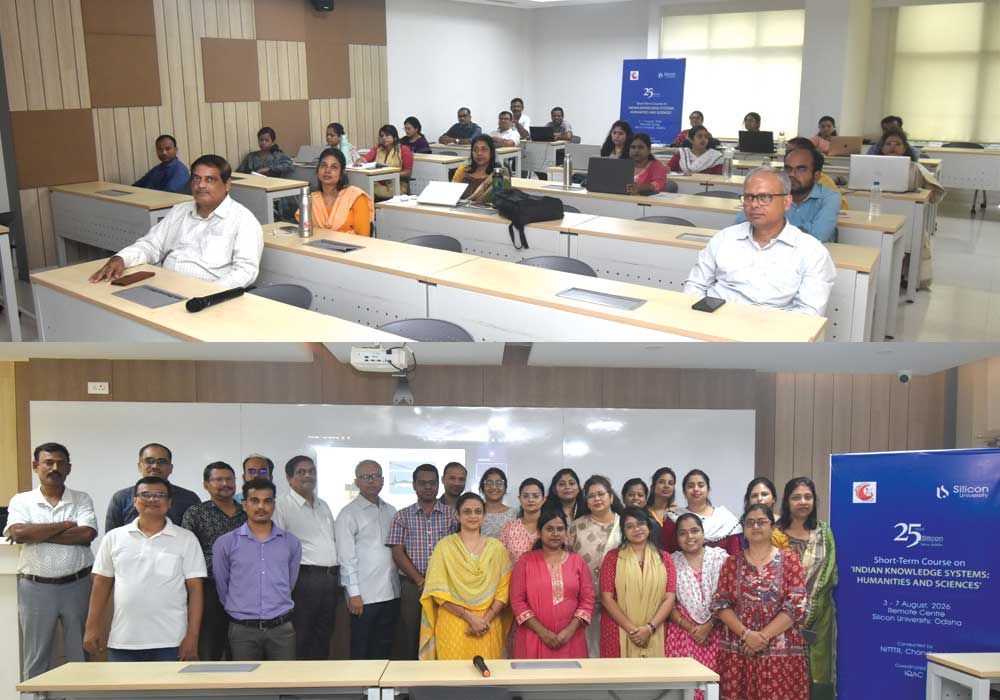
The Internal Quality Assurance Cell (IQAC) of SiliconTech, the engineering institute of Silicon University, organized a five-day Short-Term Course on ‘Indian Knowledge System: Humanities & Sciences’ in collaboration with the National Institute of Technical Teachers Training and Research (NITTTR), Chandigarh, from 3 – 7 August 2026.
SiliconTech served as the remote centre for the program, which brought together twenty-seven participants to explore India’s rich intellectual, scientific, cultural, philosophical, and educational traditions. The inaugural session was conducted by Dr. Ashok Kumar, Associate Professor, NITTTR Chandigarh, who provided an overview of the program and emphasized the requirement of 80% attendance for receiving certificates.
The primary objectives of the program were to create awareness and understanding of the diverse Indian Knowledge Systems (IKS) and their relevance in contemporary society, familiarize participants with the philosophical, scientific, cultural, social, and educational foundations of Indian knowledge traditions, and explore the relevance of IKS in addressing contemporary challenges and promoting holistic and sustainable development. Dr. Pankaj Sharma, Professor, NITTTR Chandigarh, and Dr. Ashok Kumar conducted the sessions over a period of five days.
The sessions covered a wide range of themes, including the four Vedas and their significance, Indian philosophy, linguistics, Panini’s contribution to Sanskrit grammar and the 3,983 sutras of the Astadhyayi, Yoga, Natyashastra and performing arts, Ayurveda, health and wellness, Arthashastra, agricultural sciences, veterinary and animal husbandry, Indian psychology, environmental sustainability, and women-led development. The fourth and fifth days focused on edutainment sciences, computational aspects of the Astadhyayi, and the application of IKS in engineering, science and technology, including numerical representation systems such as Katapayadi and Bhuta Saṃkhya. Quiz and discussion sessions were conducted throughout the program to encourage active participation and reinforce learning.
The course concluded with a comprehensive quiz covering the major themes discussed during the five-day program, followed by a vote of thanks expressing appreciation to the resource persons, coordinators, organizers, and participants. Overall, the program provided participants with a comprehensive understanding of India’s rich knowledge traditions and highlighted their continued relevance to contemporary education, science, technology, culture, health, and sustainable development.