

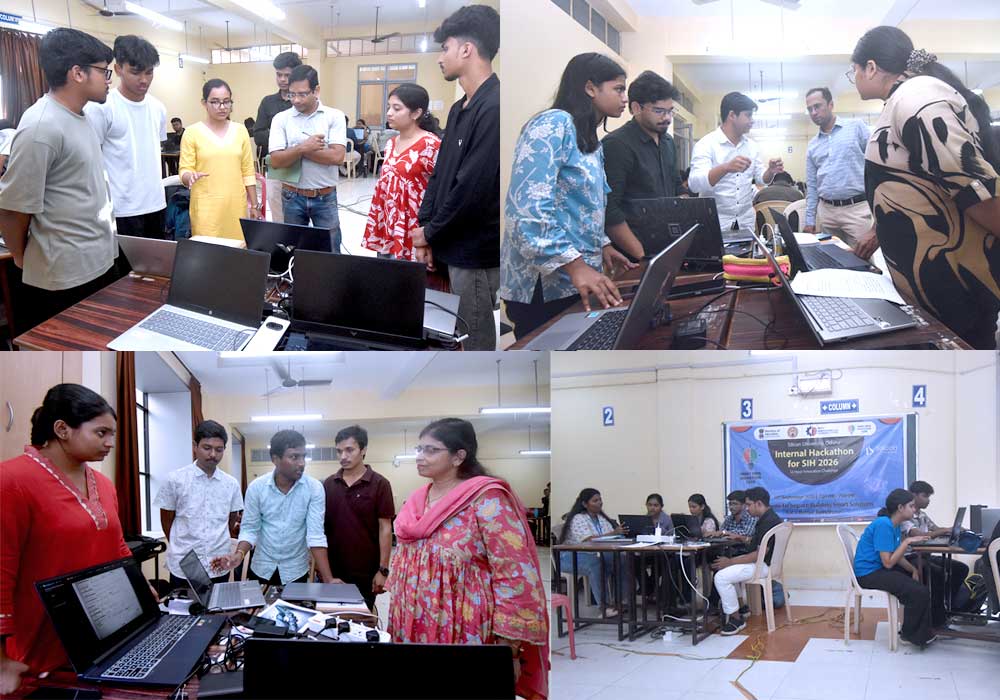
SiliconTech, the engineering institute of Silicon University, organized an Internal Hackathon as part of its institutional preparation and internal selection process for the Smart India Hackathon (SIH) 2026 on 19 September 2026.
The event provided students with a platform to identify real-world problems, develop innovative technology-based solutions, build prototypes, and demonstrate their ideas before an expert evaluation panel. The hackathon was organized by the Silicon Innovation and Promotion Cell (SIPC) team with active participation from students, faculty coordinators, mentors, and external industry evaluators.
The event was preceded by preliminary screening rounds conducted on 7 and 8 September 2026 to assess the registered teams and their proposed solutions based on problem understanding, relevance, innovation, technical approach, feasibility, expected impact, team capability, and prototype readiness. Out of 81 registered teams, 64 teams were selected for the Internal Hackathon, with a total participation of 380 students, including 139 female and 241 male participants. During the hackathon, teams engaged in development, testing, prototype preparation, presentation preparation, demonstrations, technical discussions, and evaluation.
An external evaluation session was conducted during which industry professionals and innovation experts interacted with the participating teams and assessed their solutions. The evaluation panel included Sarada Prasad Routray and Debjit Mishra, Senior Project Managers at Infosys, Sarada Raj, Consultant at Tata Consultancy Services, and Soumya Darshan Mahakul, Co-Founder of Trinovate Makerspace. The solutions were evaluated on a structured 100-mark framework covering problem understanding, innovation and creativity, technical approach, prototype implementation, feasibility and scalability, impact and relevance, UI/UX, presentation and demonstration, and teamwork and Q&A.
The SIH 2026 Internal Hackathon showcased student solutions across areas including Artificial Intelligence and Machine Learning, Generative AI, Data Analytics, web and mobile applications, cybersecurity, IoT, automation and robotics, agriculture, healthcare, education, and sustainability. The event strengthened students’ problem-solving, technical, communication, teamwork, and project-management skills while providing valuable exposure to industry-level evaluation and feedback. Institutionally, it contributed to strengthening the university’s innovation ecosystem, enhancing industry-academia interaction, identifying promising innovations, and promoting interdisciplinary collaboration, incubation, and entrepreneurship. The hackathon thus served as an important platform for preparing promising student teams for the subsequent stages of Smart India Hackathon 2026.